Begin of page section:
Page sections:

  • Go to contents (Accesskey 1)
  • Go to position marker (Accesskey 2)
  • Go to main navigation (Accesskey 3)
  • Go to sub navigation (Accesskey 4)
  • Go to additional information (Accesskey 5)
  • Go to page settings (user/language) (Accesskey 8)
  • Go to search (Accesskey 9)

End of this page section. Go to overview of page sections

Begin of page section:
Page settings:

English en
Deutsch de
Search
Login

End of this page section. Go to overview of page sections

Begin of page section:
Search:

Search for details about Uni Graz
Close

End of this page section. Go to overview of page sections


Search

Begin of page section:
Main navigation:

Page navigation:

  • University

    University
    • About the University
    • Organisation
    • Faculties
    • Library
    • Working at University of Graz
    • Campus
    Developing solutions for the world of tomorrow - that is our mission. Our students and our researchers take on the great challenges of society and carry the knowledge out.
  • Research Profile

    Research Profile
    • Our Expertise
    • Research Questions
    • Research Portal
    • Promoting Research
    • Research Transfer
    • Ethics in Research
    • Commission for Scientific Integrity
    Scientific excellence and the courage to break new ground. Research at the University of Graz creates the foundations for making the future worth living.
  • Studies

    Studies
    • Prospective Students
    • Students
  • Community

    Community
    • International
    • Location
    • Research and Business
    • Alumni
    The University of Graz is a hub for international research and brings together scientists and business experts. Moreover, it fosters the exchange and cooperation in study and teaching.
Topics
  • Sustainable University
  • Researchers answer
  • Work for us
Close menu

End of this page section. Go to overview of page sections

Begin of page section:
You are here:

University of Graz Natural sciences Department of Psychology News Vortrag von Univ.-Prof. Dr. Katja Corcoran
  • About the department
  • Our research
  • Personalities
  • News

End of this page section. Go to overview of page sections

Wednesday, 12 March 2014

Vortrag von Univ.-Prof. Dr. Katja Corcoran

Alles ist relativ!

Auslöser, Mechanismen und Konsequenzen von sozialen Vergleichsprozessen

Alles ist relativ - insbesondere die Einschätzung der eigenen Eigenschaften, Leistungen und Fähigkeiten. Der Mensch neigt dazu, sich selbst im Vergleich zu anderen einzuschätzen. Manche Vergleiche werden gezielt gesucht, andere werden einem aufgezwungen und wieder andere entfalten ihre Wirkung ohne dass wir uns dessen überhaupt bewusst sind. Je nachdem mit wem und wie wir uns vergleichen, fühlen wir uns fähig oder unfähig, sind motiviert oder demotiviert und fühlen uns gut oder schlecht. In meinem Vortrag werde ich in die Theorie zu sozialen Vergleichsprozessen einführen und anhand des Modells der selektiven Zugänglichkeit erklären, warum Vergleiche manchmal zu Assimilation an den Standard und manchmal zu Kontrast führen. Darauf aufbauend werde ich die Bedeutung von sozialen Vergleichen in unserem Alltag beleuchten. Dabei möchte ich exemplarisch auf Vergleiche im Klassenzimmer, auf Vergleiche mit Mediengestalten und auf die Bedeutung von Vergleichen im Gesundheitswesen eingehen.


ZEIT: Dienstag, 25. März 2014, 19:15 Uhr

ORT: HS 02.21 - Institut für Psychologie, Universitätsplatz 2/II, 8010 Graz
Related news

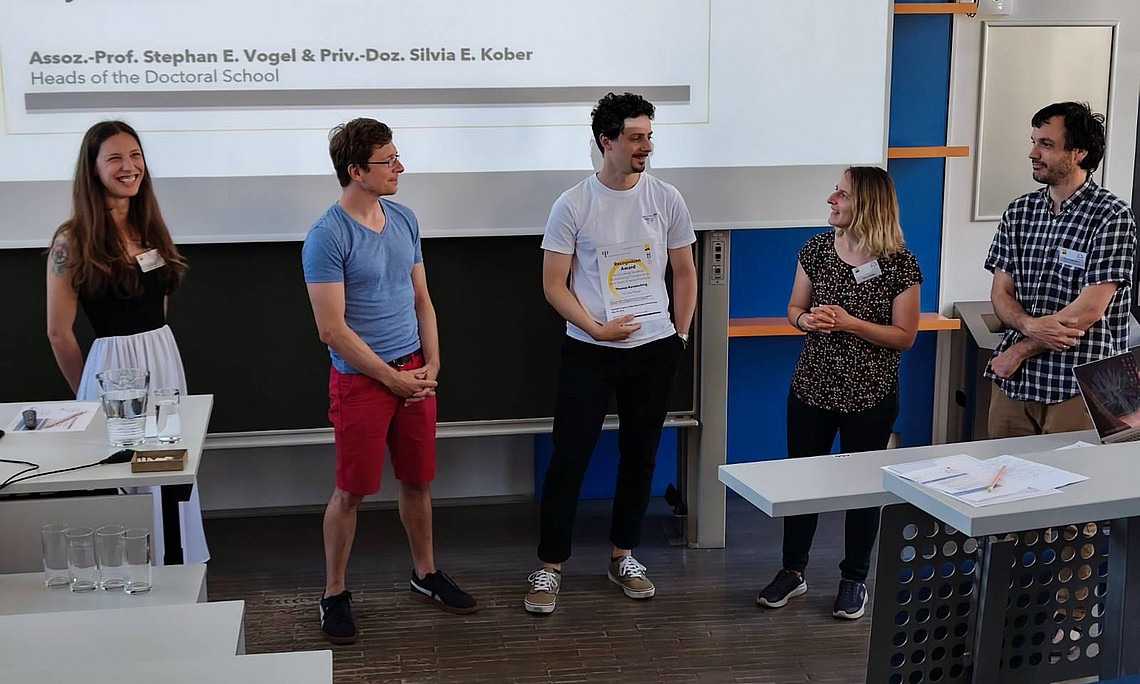
Open Science Award 2025/26 für Thomas Kanatschnig

Thomas Kanatschnig (mittig im Bild) gewinnt den Open Science Award 2025/26 der Doktoratsschule

Publikation in Nature Human Behaviour

Unter Mitarbeit der Universität Graz (Prof. Dr. Schwerdtfeger) ist es einem internationalen Forschungsteam gelungen, die heterogenen Daten zu Bewegungs-Stimmungszusammenhängen im Alltag zusammenzufassen

Inge St Forschungspreise für Dissertationen

Die heurigen Forschungspreise der Inge St (Initiative Gehirnforschung Steiermark) für die besten Dissertationen gingen beide an das Institut für Psychologie.

Neues EU-Projekt in der Arbeits- und Organisationspsychologie

Das Projekt "Guided Robotic-human Orchestration with Wearables for manufacturing: Twin Transition Through Tactile Teaming" (GROWT5) wird im Rahmen von Horizon Europe von der Europäischen Kommission gefördert.

Begin of page section:
Additional information:

University of Graz
Universitaetsplatz 3
8010 Graz
Austria
  • Contact
  • Web Editors
  • Moodle
  • UNIGRAZonline
  • Imprint
  • Data Protection Declaration
  • Accessibility Declaration
Weatherstation
Uni Graz

End of this page section. Go to overview of page sections

End of this page section. Go to overview of page sections

Begin of page section:

End of this page section. Go to overview of page sections